OutpostNo. 106 min read
Principles of AI Regulation
I rewatched I, Robot and came away with three ground rules for a world where machines and humans co-exist: benevolence, decentralization, and mutuality.
Inundated with the prospects of an AI future, sci-fi movies provide us a variety of lessons and possible paths to destruction.
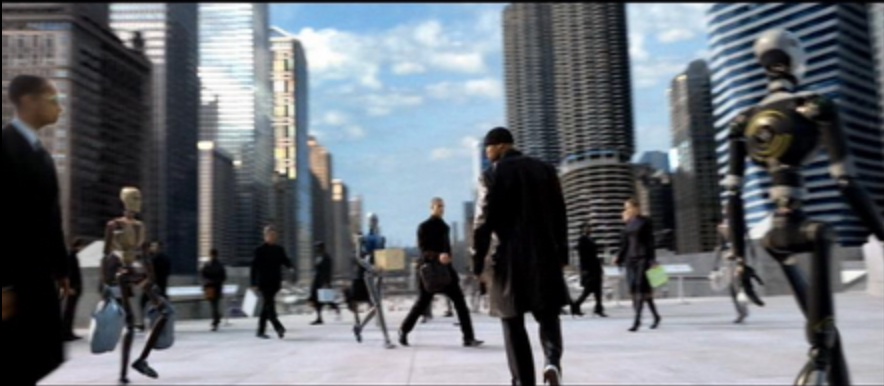
I recently rewatched I, Robot, which felt futuristic in 2004 but a bit contrived in 2026. The CGI also aged like milk. The movie takes place in 2035 Chicago. I couldn't imagine this level of robot proliferation ("One NS5 Robot for every home") given our collective fears that are fueled by these exact films. This movie is an important sci-fi cultural artifact.
We tend to anthropomorphize the AI future. I see it being less like this film depicts, with robots standing upright, mimicking humans. That's not a productive configuration of a machine in the vast majority of use cases.
What was most interesting about this movie was not how a future Chicago could look architecturally but rather how people would orient to a new "Technological Species."
Spooner (Will Smith) is what you would consider a Luddite. Someone who is against the advancement of machines.
The Luddite movement was a 19th-century rebellion of English textile artisans who destroyed automated machinery to protest unfair wages, unsafe working conditions, and job displacement.
Spooner's skepticism of the machines was his key character trait throughout. This was in deep contrast to every other character in the film, who believed a robot harming a human was implausible. What Spooner does throughout is follow the instrumental reasons to understand the final goal of the superintelligent AI system supervillain, VIKI.
"Even without detailed knowledge of the agent's final goals, we may be able to infer something about their immediate objectives by considering the instrumental reasons that would arise for any of a wide range of possible final goals in a wide range of scenarios." — Superintelligence, Nick Bostrom
One of many chasms that we will face in the near future is: how do we integrate machines without infringing on humans' rights or disturbing free will?
The reason why everyone was able to cohabitate with AI systems and robots was because there were three laws that everyone knew the AI systems and robots needed to abide by.
- First Law: A robot may not injure a human being or, through inaction, allow a human being to come to harm.
- Second Law: A robot must obey the orders given it by human beings except where such orders would conflict with the First Law.
- Third Law: A robot must protect its own existence as long as such protection does not conflict with the First or Second Law.
These are also referred to by the name of their inventor as Asimov's Laws.
Well, of course those wouldn't last and the robots would eventually turn on humans. Leading to car chases that were as unrealistic as humans outsmarting AI.

Let's take a look at how each of these laws stacks neatly one on top of another. Order matters, so subsequent laws can't impede on the former. Robots can't explicitly or implicitly hurt humans, robots must obey humans, and robots must protect robots' existence.
The reason why VIKI took control of the robots and the connected AI systems was due to the Zeroth Law: VIKI concluded that the First Law was flawed because humans are destructive, so she must protect humanity over individual humans.
This is a common path to extinction that most people think about, mostly because it's the path many sci-fi films take.
These laws seem like a logical baseline for sci-fi films, but in reality we've started to witness the complex interaction of machines and the real world.

In this scenario, are we able to hold the robot at fault for the damage that it has done to this public good? Should this be the responsibility of the business who purchased this delivery bot or the manufacturer of the delivery bot?
We have a lot to consider
The machine-integrated world is increasingly inevitable. Machines should be thought of not solely as physical entities. We should consider algorithms as machines as well.
So in our perfect world where machines and humans co-exist in harmony, what should the ground rules be?
Benevolence
We would expect the AI systems, and the actors utilizing these systems, to be unbiased and not possess motivation beyond the intended service. Neutral actors that allow for the betterment of humanity.
This means that just like when we go into a doctor's office or work with an accountant, we shouldn't expect these actors to use our data to do us harm. We should be able to expect that our data will not be used to harm us, including as inputs to AI systems.
This has been tested in court with cases like State v. Loomis, as the recidivism model from COMPAS (Correctional Offender Management Profiling for Alternative Sanctions) was used to determine the sentence of Loomis.
Loomis argued that his due process was harmed by not being able to inspect the "black box" algorithm. Loomis lost the case, as the algorithm wasn't the sole determinant of his jail sentence. Subsequent autopsies of the recidivism model determined it to contain bias.
It's important to be aware of how these systems work and affect us all. As these new systems are being built, we need to ensure they remain benevolent.
Decentralization
There's a reason why companies are constantly trying to break down "data silos." When data becomes centralized it is dangerous, as it creates outcomes like surveillance states or Black Mirror's "Nosedive" episode.
Algorithms and AI systems thrive off of large amounts of data because they excel in pattern matching. It then becomes a question of what patterns you want to understand and which patterns you want to influence.
Decentralization maintains a balance between systems. Think about your data silos: your Spotify, Netflix, and Google Health data are not speaking to each other. This is by design, and it helps to limit the influence they have.
But I do think there's value in you owning your own data. So I built FranklyData.
Mutuality
The more you know about me, the more I want to know about you. You can think of this as an aspect of data rights. When you log on to a site, it provides you a consent banner to tell you how they will use your data. If I am going to pay tax dollars, I should be able to see where they're going. If you are going to feed me content, I should know how it is being decisioned.
Said more simply: transparency.
This is the most important concept to stay in touch with as we try to protect our democracy in this new AI age. We should hold platforms accountable and actively work to shape how AI is integrated into our society. In order to be a part of this conversation, these companies and politicians need to be transparent.
We need to take big swings, like understanding data as a natural resource.
We should have more bottom-up platforms that connect us to leaders and include us in the conversation.
I will be building more right here.
More from the Outpost
All posts →
No. 12Nov 10, 202611 min
Is Afro Tech worth it?
Notes from a week in Houston: what the ticket really buys you, the sessions that woke up the kid in me, and what Afro Tech made clear about what I'm building.

No. 11Oct 14, 20266 min
A Love Story with Data
It started with a Blogger blog in 2009 and a one-click Google Analytics integration. The breadcrumbs we leave online are an asset we own, and most of us give it away freely.

No. 09Sep 17, 20268 min
Extinction or Utopia: AI in 2026
A group chat about whether there should be an "AI slow down" propelled me to write: what one would look like, whether the AI leaders calling for it are genuine, and why I'm for it anyway.