OutpostNo. 098 min read
Extinction or Utopia: AI in 2026
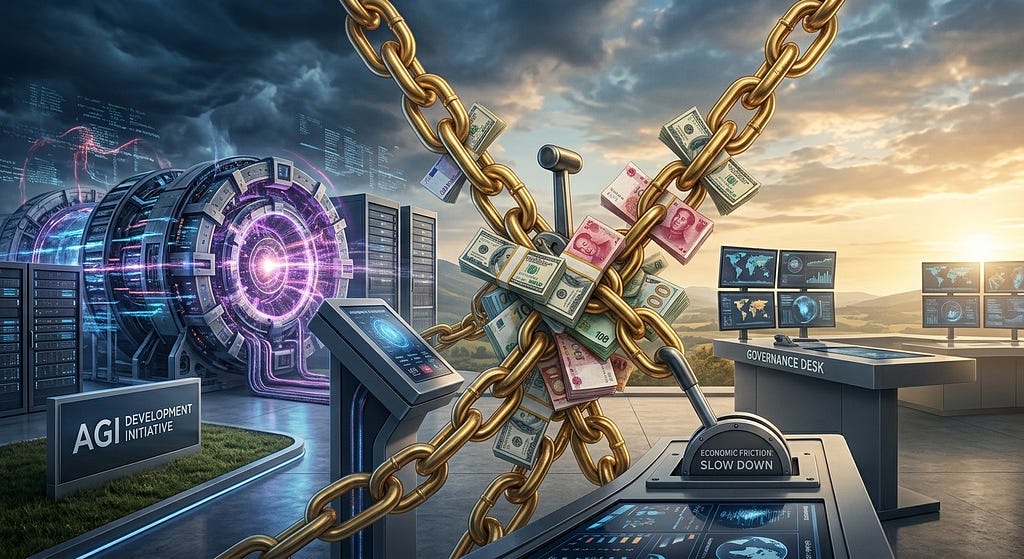
A group chat about whether there should be an "AI slow down" propelled me to write: what one would look like, whether the AI leaders calling for it are genuine, and why I'm for it anyway.
I strive to lend a thoughtful, open-minded, technically inclined, culturally aware, pragmatic lens to where technology, society, and the economy are headed. My opinion is shaped by my AI-indoctrinating corporate day job and my entrepreneurial build-fast mind, which has shipped a few sites this past year.
My opinion on AI shifts periodically due to me building and consuming. Consuming content across the spectrum. Content like how best to build with AI and the after-report on the Hugging Face hack.
A group chat conversation has propelled me to write. Dialogue around whether there should be an "AI slow down" is quite interesting.
How I interpret an "AI slow down"
A regulatory framework that allows for a third party (an NGO, civic, or public body) to regularly monitor the intelligence of the models. A trusted third party to constantly administer the Turing test and produce a threat report. New legislation is needed to define interesting questions like, "How do we treat agents that commit crimes?" I don't know why there is not a legal investigation into the OpenAI hack on Hugging Face, given hacking is a cyber crime.
International diplomacy, with the equivalent of a UN body to govern it. It would be great if there were representative agents from each country that could negotiate. But we'd be getting too close to a utopia. More on that later.
Setting a ceiling to define what's "too smart" seems like a given, considering every sci-fi movie ever. We should have a predefined limit to intelligence. Even if we're not there in the next five years, it should be defined. There are many ways to describe extinction, but just the thought of creating a species more intelligent than humans should give pause, possibly literally.
Are AI leaders genuine?
The question becomes: are these AI leaders genuine about wanting to slow down the AI race out of fear, or is there a money motive? Anthropic's CEO claims that he wants to slow down the race and have more help in shaping the future of AI.
The CEO of Anthropic used to work at OpenAI until he and a team of engineers quit due to ethics concerns and started Anthropic. He also stood up to the Pentagon when they asked to use the Anthropic models for autonomous killing and mass surveillance. I see Anthropic as having the most calibrated moral compass and a solid product. That's why I primarily build on Claude.
Anthropic did submit the initial IPO paperwork required to go public in June of 2026. This initial review period by the SEC is ongoing.
Before Anthropic is added, AI-linked firms account for 36% of the stock market and 50% of the recent S&P growth. SpaceX just went live with a trillion-dollar public offering.
During this SEC review period, Anthropic is calling for an "AI slow down." Why would they do that, as it signals to the market that the pace will slow and possibly less future profits? Less money presumably will flow to the IPO.
Maybe the "AI slow down" will cement Anthropic's place in the industry through regulation and putting a ceiling on intelligence growth. Essentially pulling up the ladder for smaller firms. When Anthropic goes public they will demand capital, and capital is not infinite, so they will crowd out smaller competitors.
Smaller, less expensive models have shown promise and are a true threat. Remember when DeepSeek first came out. The true value is building out systems with AI integrated that run efficiently at defined business processes.
As with the dot-com bubble, there will be winners and losers. This race is no different. It would be naive of me to think that there are no capital motives driving the CEO of Anthropic.
But I'm more apt to believe that the Anthropic CEO is raising the flag to say there should be more inputs into this technology that will greatly impact everyone. Slowing the pace of model releases to allow for more inputs could yield longer-term adoption benefits. Maybe I'm naive, but I truly believe he sees an inherent danger in creating a machine smarter than us.
Pointing out a few things to shape the lens
Recession: A recession is two consecutive quarters of GDP decline. GDP is the total amount of goods and services produced. The last real recession we had was in 2008, and it lasted 18 months. During the pandemic it lasted for two months. Right now, 50% of our year-over-year GDP growth is concentrated in AI-connected companies.
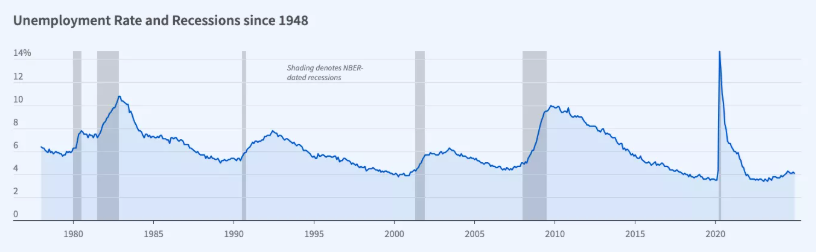
I feel like we may be due for one that's more extended. And if it does happen, AI will be a large component of it. This may be what sits us all down to truly think about the impact of AI.
Tech oligarchy: The previous oligarchy fueled the movement of the economy across railroads that were forged in steel and financed by capital. Rockefeller, Vanderbilt, Carnegie, Morgan.
Data is the fuel of the digital economy. It is transported and housed in physical and digital infrastructure, computed on chips, orchestrated through networks, made intelligent by AI, and served on devices. Technology companies are vertically integrated, so I can't arrange the founders as orderly as above. But you know them: Musk, Zuck, Bezos, Ellison, Page, Brin, and now Altman (OpenAI) and Amodei (Anthropic). We need to have better mechanisms to exert accountability on this group to build towards utopia, not dystopia.
Data rights: You see this in the Flock cameras. All of this data being collected about us without consent. Data centers are a big topic. Overall we don't have a collective conscience of the value of data. We do not collectively exercise our data rights to maximize our return on data. Questions like how our data can be used algorithmically. There shouldn't be intentional dumbing down of a population. We have a right to influence algorithms and the way we integrate AI into our society. Meta was just made to pay $17.1 billion due to the harm they've had on our children. Seems overdue in some ways.
We are still figuring out how to navigate social media, and now here comes the AI wave. Awareness about how data creates value is going to be important as AI continues to normalize.
Now how scared should we be?
Our imagination is bound to anthropomorphize the potential impacts of AI. Terminator is the best example of this: a humanoid robot that is faster and smarter. We think narrowly on how far-reaching AI will be.
Artificial general intelligence would allow for a machine to function as a human would. The consensus is AGI is three to six years out. Now what will be the velocity of intelligence growth at AGI? It certainly won't stay at that level for long. A high school student to college graduate in one year? Month? Hour?
So it would then move into superintelligence. In layman's terms, I would describe superintelligence as multitudes smarter than the smartest human.
Evolution nods to humans' intelligence as the central competitive advantage. And opposable thumbs.
Superintelligence outperforms humans across many different cognitive domains. Right now a calculator is better at arithmetic, a power drill is better at screwing, AlphaGo is better at Go, Watson is better at Jeopardy, but these are all specific tasks that humans are used to being inferior at.
So how might we break down superintelligence into composable forms?
Well, there's speed of intelligence: human intellect, magnitudes faster. Collective superintelligence brings together mass amounts of smaller intellects so that the overall performance is far superior. Think about trying to get to a collective answer and deliverable amongst a room of really smart people. Lastly there is the quality of intelligence, which we can think of as the collection of cognitive abilities that we possess over nonhuman animals.
There are multiple paths to superintelligence. One path would be to emulate the human brain: firing neurons, recreating the hippocampus, and constructing a full brain able to process, strategize, and think more deeply than any human. Another path could be to augment the brain itself with a chip, enhancing the functionality of the brain so that a human might possess intelligence and connectivity far surpassing anything that we have seen. This is currently in testing with Neuralink. Another path would be to connect, through a network, a system of humans and bots through different interfaces and artifacts, a sort of "collective intelligence." If you have ever watched the show Pluribus, you get a taste of this.
Understanding the paths to superintelligence can start to paint the picture as to how we might get there, and with so many different paths it seems inevitable.
Why I am pro AI slow down
Given how much smarter models are today than when I first met them, I know AI will continue to be an integral piece of each of our lives. No matter how tempting it is to be a Luddite or live off the grid, it's going to be a component of the average person's life because it will connect them to the economy.
Artificial general intelligence will be a milestone in history that will shift the timeline. It will have the ability to eradicate hunger through efficiently orchestrating harvesting, weather, resources, economics, and politics to ensure optimal allocation of resources. It can find cures for diseases that have plagued humans.
There are also the more localized benefits, like a "nanny AI" which will make your life significantly easier. A true assistant with your best interest in mind. Working on your behalf to help you accomplish goals, solve problems, and give you more free will.
In order for these great benefits to happen, we need to figure out how best to connect systems and bridge communication amongst agents. These models are already quite smart. Thus, I don't believe slowing down the rate of intelligence growth would negatively affect our progress towards these lofty goals, as "intelligence" is only one component of AI.
Slowing down AI to involve more parties is actually an invite for individuals to have more say in the direction of AI. We should be pushing towards a uniform set of rules to hold these AI companies to. We should have rules in place prior to creating a species smarter than humans.
Maybe neither extinction nor a utopia is on our horizon, but I hope it's a brighter, more abundant life for those who come after us.
More from the Outpost
All posts →
No. 12Nov 10, 202611 min
Is Afro Tech worth it?
Notes from a week in Houston: what the ticket really buys you, the sessions that woke up the kid in me, and what Afro Tech made clear about what I'm building.

No. 11Oct 14, 20266 min
A Love Story with Data
It started with a Blogger blog in 2009 and a one-click Google Analytics integration. The breadcrumbs we leave online are an asset we own, and most of us give it away freely.
No. 10Sep 24, 20266 min
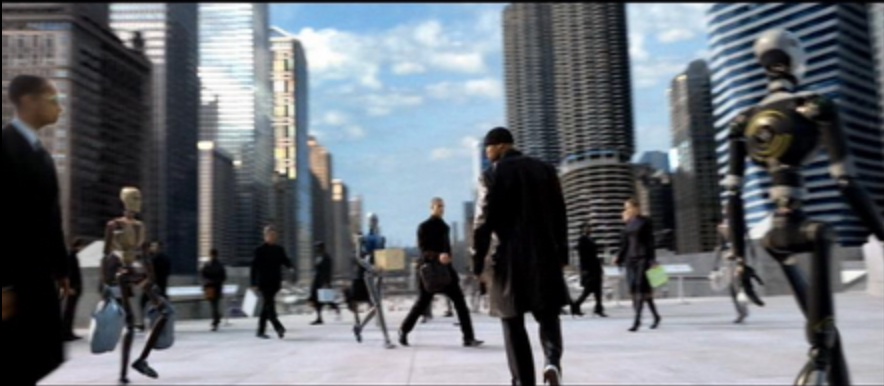
Principles of AI Regulation
I rewatched I, Robot and came away with three ground rules for a world where machines and humans co-exist: benevolence, decentralization, and mutuality.